Year of Drought, Locusts, and Dying Cattle
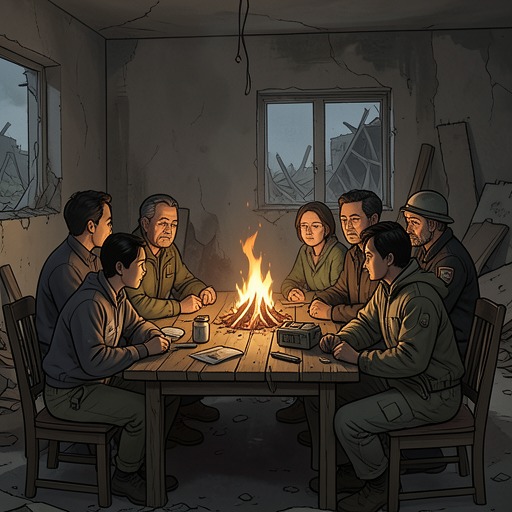
Earth AbidesYear of Drought, Locusts, and Dying Cattle is the sixth year of Ish’s community calendar, a season when drought, hungry Cattle, and Grasshoppers compound one another’s effects. The crisis wrecks the community’s vegetable plot, kills cattle by the hundreds, and makes the land appear barren. Yet the year also brings four births and ends with rain and new grass: its name, Bad Year, preserves the people’s fear at the height of the disaster, even as the recovery that follows challenges their despair.
Conditions at the start of the year
The environmental crisis arrives after Cattle have multiplied during earlier years of relative abundance. Their numbers had already made them a nuisance: people could obtain meat, but they also had to watch for charging bulls. By the sixth year, drought and scant grass turn that abundance into vulnerability. The cattle grow thin and wander in search of food, carrying the consequences of an earlier population increase into a season that cannot sustain them.
The year is also marked by a growing human population. All four women bear children, including Maurine, who had seemed too old to do so. Since Em had led the way, the adults had embraced having many children. Each had experienced life alone before forming the community, and knew the dread they called the Great Loneliness. The group remains small beside the surrounding darkness, but its ten children now outnumber its adults; Evie is treated as belonging to neither count. In this way, the year’s opening juxtaposes human continuity with mounting ecological insecurity: the community grows as the conditions around it worsen.
The collapse of the garden and pasture
One night, the hungry Cattle break through the strong fence around the small vegetable plot. The men rush out and fire their rifles at close range, but the herd cannot be driven off before it has ruined the garden. The damage comes not from the cattle eating the crops, but from their trampling them in the confusion. The community’s carefully protected food supply is thus destroyed by the very animals that had seemed to offer plentiful meat.
The Grasshoppers then consume what the Cattle have not reached. They strip leaves from trees and eat the flesh of ripening peaches, leaving seeds on bare branches. Their sudden abundance is followed by their death, and the insects’ remains become a further sign of the scale of the disruption. Afterward, Cattle die by the hundreds in dry streambeds and muddy waterholes. The grass is scarce, the garden gone, and the land stripped; to those living through it, the damage seems so complete that recovery is difficult to imagine.
Fear and competing explanations
Ish tries to explain the disasters as part of the ecological readjustment after the loss of human control. In the absence of cultivation, he reasons, Grasshoppers have been able to breed in conditions favorable to them. But the explanation does not dispel the people’s fear. The devastated landscape is immediate evidence, while the processes Ish describes are harder to see and offer no assurance that food or water will return soon.
The response divides the community. George and Maurine turn to prayer, while Jean openly mocks their confidence in it, pointing to the events of recent years. The children respond differently according to their age and circumstances: the older ones continue to drink canned milk and accept the dying cattle as part of their world, while the nursing babies become fretful and distress their mothers in turn. October is remembered as a month of horror. The year’s crisis is therefore not only a loss of food and wildlife; it tests Ish’s ability to make ecological change intelligible and the group’s ability to maintain confidence when explanations cannot immediately relieve hardship.
Rain, naming, and what follows
Two weeks after the first rain, the hills show faint green grass. Molly and Maurine weep with pleasure, and Ish feels relief as well. The people’s despair had shaken his confidence in the earth’s capacity to recover, and he had begun to doubt whether any seeds remained. The first shoots answer that fear, but do not erase what has happened: recovery begins after the plot has been destroyed and cattle have died in great numbers.
At the winter solstice, the community gathers at the smooth rock where it cuts the year’s numeral and chooses a name. It considers names that would emphasize the four births, the dead Cattle, or the Grasshoppers. In the end, the year’s evil weighs most heavily, and they call it Bad Year. The choice turns a sequence of environmental shocks into shared memory, preserving how the disaster felt rather than claiming that every consequence was permanent.
The following year brings another ecological reversal. Mountain lions, which had evidently multiplied when Cattle were plentiful, now close in after the drought has deprived them of food; people carry rifles and keep dogs close, and four dogs are taken. The sequence extends the meaning of Bad Year beyond a single failed harvest: changes in one population alter the pressures on others, and the effects continue after the rain. In the wider aftermath of the Great Disaster, the community’s experience makes Ish’s account of ecological readjustment concrete. A landscape no longer managed by people can support sudden abundance and abrupt scarcity, while the survivors must learn that human recovery and environmental recovery do not proceed at the same pace.